Berberine vs Metformin: What Happened When Researchers Tested Them Side by Side
One is the world’s most prescribed diabetes pill. The other is a plant extract used for centuries. When researchers gave them to matched groups of patients for three months, the results explained why the comparison keeps coming up — and exactly where it stops.
If you have spent any time reading about blood sugar online, you have probably seen berberine called “nature’s metformin”. It is the kind of phrase that makes doctors wince and marketers smile. So it is worth asking the obvious questions: where did the comparison come from, and how much of it holds up?
The short answer is that it started in the research literature, not on social media. The longer answer is more useful — particularly if you are trying to decide whether berberine belongs in your routine, or you already take metformin and wonder how the two relate.
Two very different origin stories
Metformin traces its roots to French lilac (Galega officinalis), a plant used in medieval Europe for symptoms we would now recognise as diabetes. Refined into a modern drug, it has been the first-line oral treatment for type 2 diabetes for decades and sits on the World Health Organization’s list of essential medicines.
Berberine comes from the roots and bark of plants such as Indian barberry (Berberis aristata) and Chinese goldthread (Coptis chinensis). It has been used in Ayurvedic and traditional Chinese medicine for more than two thousand years, mostly for digestive complaints, and entered the modern clinical literature in the early 2000s.
Chemically, the two molecules have almost nothing in common. Biologically, they turn out to share a great deal.
Chemically, the two molecules have almost nothing in common. Biologically, they turn out to share a great deal.
The same switch, flipped the same way
Metformin’s main job is to stop the liver releasing too much glucose into the blood between meals and overnight. Research published in the journal Diabetes in 2004 showed one way it does this: it mildly inhibits part of the mitochondria, the cell’s power plant, known as complex I. The cell reads that as an energy shortage and switches on AMPK, its master energy sensor.
In 2008, a study in the same journal showed that berberine does the same thing, through the same part of the mitochondria. Once AMPK is on, the downstream effects are similar: less glucose released by the liver, more glucose taken up by muscle, and less new fat and cholesterol made.
There are differences, too. Berberine also increases the number of LDL receptors on liver cells — the receptors that pull “bad” cholesterol out of the blood — through a mechanism described in Nature Medicine in 2004 that is distinct from how statins work. That is one reason berberine trials often report bigger improvements in cholesterol and triglycerides than metformin trials do.
The head-to-head trial
The comparison became famous because of a 2008 study in the journal Metabolism. Researchers gave adults newly diagnosed with type 2 diabetes either berberine or metformin, 500 mg three times a day, for three months.
At the end, the two groups showed statistically similar reductions in HbA1c, fasting glucose and post-meal glucose. The berberine group also saw larger falls in triglycerides and total cholesterol. In a second part of the same paper, adding berberine to the existing treatment of people whose diabetes was poorly controlled improved their numbers further.
Later work broadly agreed. A 2012 systematic review pooled 14 randomised trials with 1,068 participants and found no significant difference in blood-sugar control between berberine and standard oral medicines such as metformin, while berberine combined with lifestyle change outperformed lifestyle change alone.
Where the comparison breaks down
This is the part the “nature’s metformin” posts leave out. Metformin has decades of data behind it, including the UK Prospective Diabetes Study, which followed patients for years and linked metformin to fewer diabetes-related complications in overweight patients. Berberine has nothing comparable. Its trials are mostly small, mostly three to six months long, and mostly conducted in China.
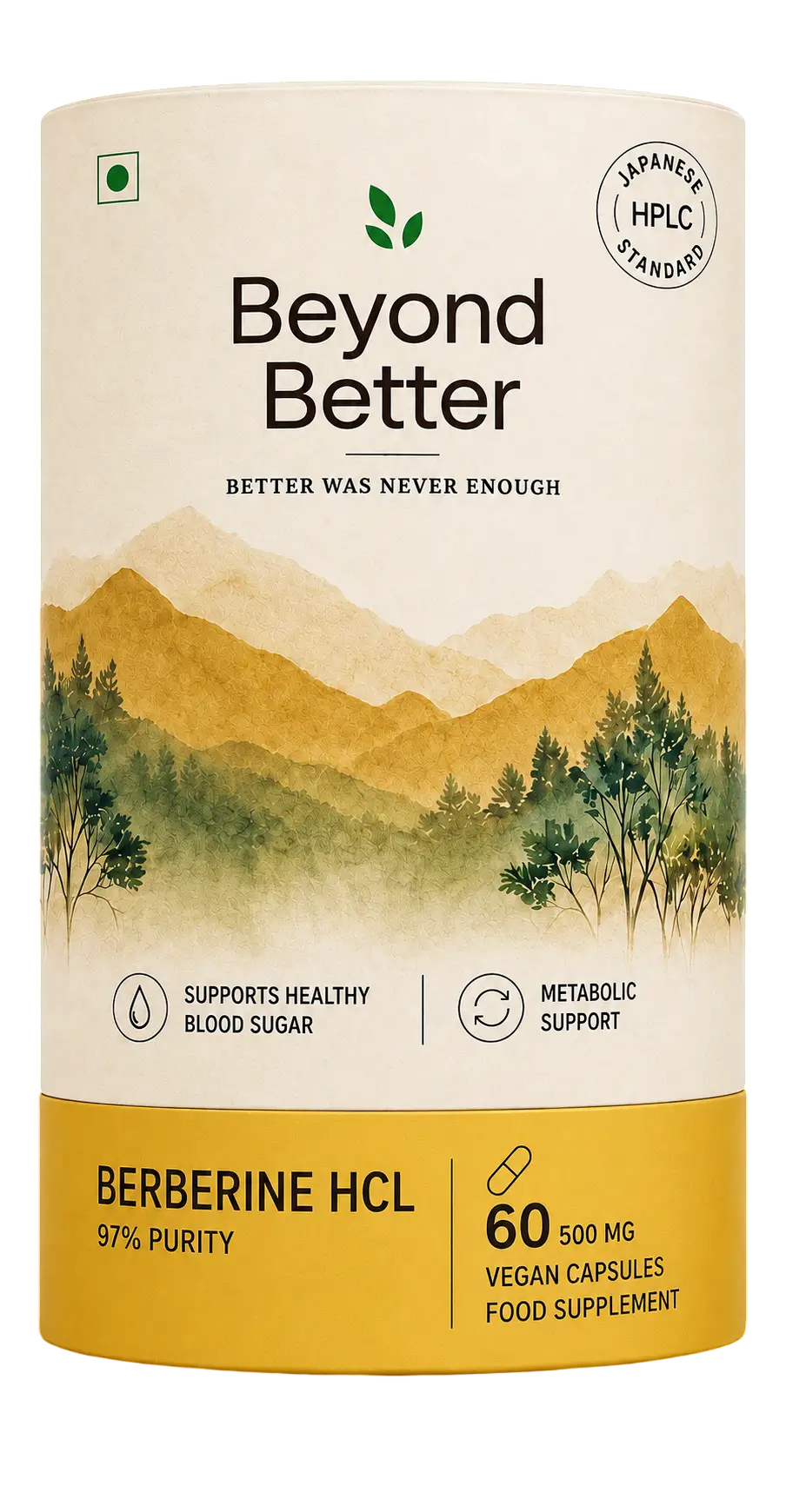
There is also the question of what is in the pill. Metformin is a regulated medicine: every tablet contains a standardised dose made under drug-manufacturing rules. Berberine is sold as a food supplement. The dose used in trials was precise; the dose in a supplement is only as reliable as its testing.
- Metformin: decades of long-term outcome data. Berberine: short trials measuring blood markers.
- Metformin: a prescription medicine with a regulated dose. Berberine: a supplement whose quality varies by brand.
- Both: can cause digestive side effects, and both lower blood sugar — which matters if you combine them.
Who the comparison actually matters for
If you have been prescribed metformin, the comparison changes nothing about what you should do: keep taking what your doctor prescribed, and raise berberine with them rather than swapping one for the other. Because both lower blood sugar through overlapping routes, combining them without supervision can push glucose too low.
The comparison matters most for a different group: adults who have not been prescribed anything, whose numbers are drifting in the wrong direction, and who are working on diet and activity. For them, knowing that a plant extract has held its own against a first-line medicine in controlled trials is a reasonable starting point for a conversation with their doctor.
If you take one thing from the comparison, make it this
Metformin’s reliability comes from manufacturing standards: you know what is in every tablet. If berberine is going to be compared with a medicine, it deserves to be held to something closer to that standard.
That means a stated dose of berberine hydrochloride per capsule, a lab report for the batch you are buying, and testing for contaminants as well as purity. Most brands offer none of these. Here is how to check.
If you are considering berberine
Start with your doctor if you take any medication, especially for diabetes or blood pressure. In trials, berberine was usually taken as 500 mg two or three times a day with meals. Give it around 12 weeks, then recheck your HbA1c or fasting glucose so you are comparing like with like.
Expect the first week or two to be the hardest on your stomach; taking each dose with food helps.
The verdict
Berberine earned the comparison honestly: it acts on the same cellular switch as metformin, and in head-to-head trials its short-term effect on blood sugar was similar. But it is not a substitute for a prescribed medicine, and it lacks metformin’s long-term record.
What the comparison really tells you is that berberine is worth taking seriously — which is exactly why the quality of the berberine you choose matters.
Reader questions
Can I take berberine instead of metformin?
No. Any change to a prescribed medicine must be made with the doctor who prescribed it. Berberine is a supplement worth discussing for adults who have not been prescribed medication.
Can I take berberine and metformin together?
Some trials have combined them under medical supervision, but because both lower blood sugar, the combination can push glucose too low. Only do it with your doctor’s guidance and monitoring.
Is berberine as strong as metformin?
In short head-to-head trials, the effects on blood sugar were statistically similar. Metformin, however, has decades more safety and outcome data.
Do they have the same side effects?
Both commonly cause digestive symptoms. Berberine’s tend to be mild and concentrated in the first week or two; taking it with meals helps. Long-term metformin use is also associated with lower vitamin B12 levels.
Sources
- Yin J et al. — Efficacy of berberine in patients with type 2 diabetes mellitus. Metabolism, 2008.
- Dong H et al. — Berberine in the treatment of type 2 diabetes mellitus: a systemic review and meta-analysis. Evidence-Based Complementary and Alternative Medicine, 2012.
- Turner N et al. — Berberine and its more biologically available derivative, dihydroberberine, inhibit mitochondrial respiratory complex I. Diabetes, 2008.
- Brunmair B et al. — Thiazolidinediones, like metformin, inhibit respiratory complex I. Diabetes, 2004.
- Kong W et al. — Berberine is a novel cholesterol-lowering drug working through a unique mechanism distinct from statins. Nature Medicine, 2004.
- UK Prospective Diabetes Study Group — Effect of intensive blood-glucose control with metformin on complications in overweight patients with type 2 diabetes (UKPDS 34). The Lancet, 1998.