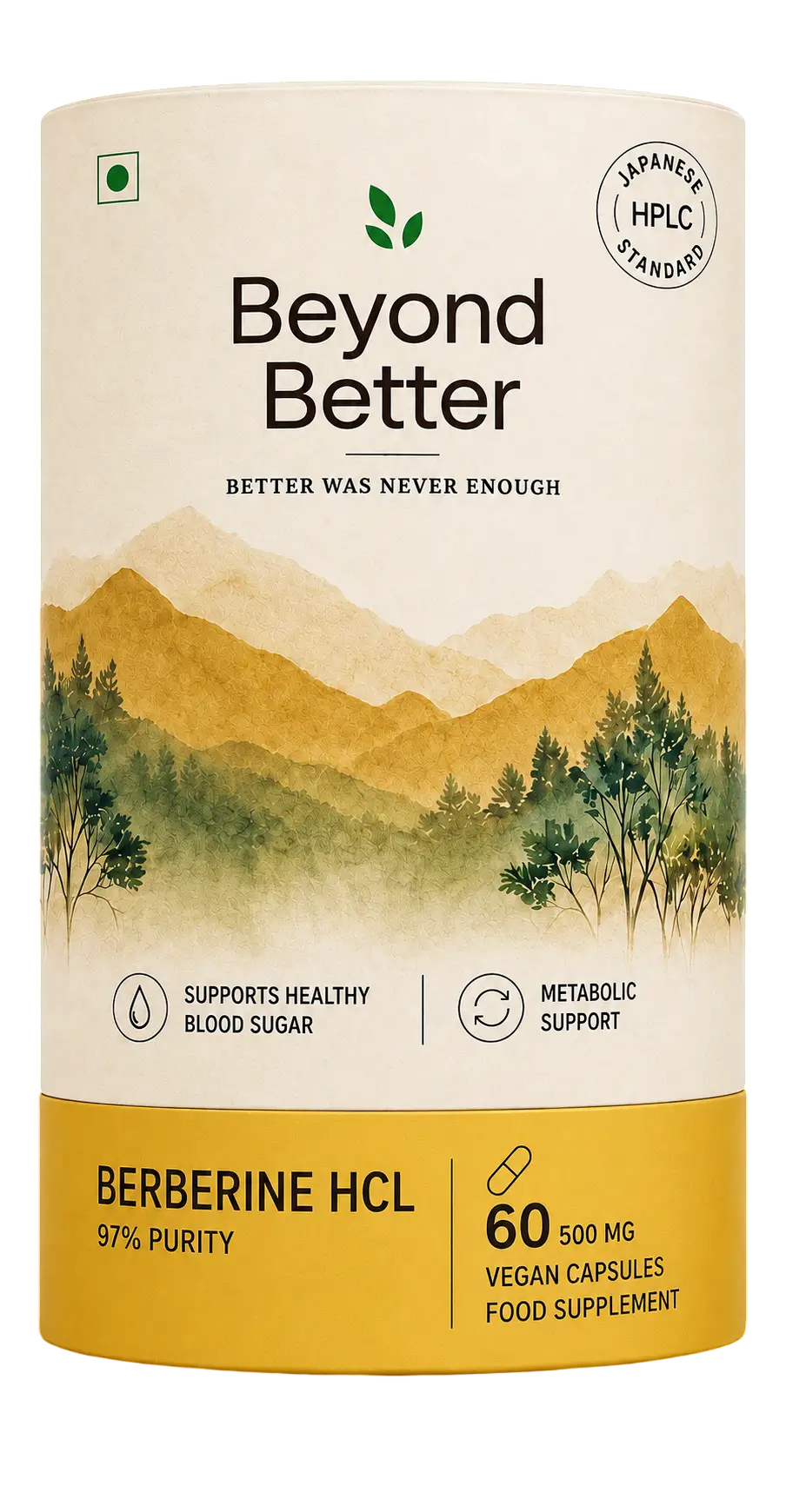
The ‘500 mg’ on Your Supplement Label Might Not Mean What You Think
Two bottles can both say “berberine 500 mg” and contain very different amounts of the active compound. How purity is really measured, what the numbers on a lab report mean, and the questions that expose an empty claim.
Put two berberine bottles side by side and they may look identical on paper: 60 capsules, 500 mg each. One could deliver close to 500 mg of berberine hydrochloride in every capsule. The other could deliver far less — and nothing on the front of the bottle would tell you which is which.
That gap is where most of the quality variation in the supplement aisle hides. Closing it takes a specific kind of test, and a willingness to show you the result.
Extract weight is not active dose
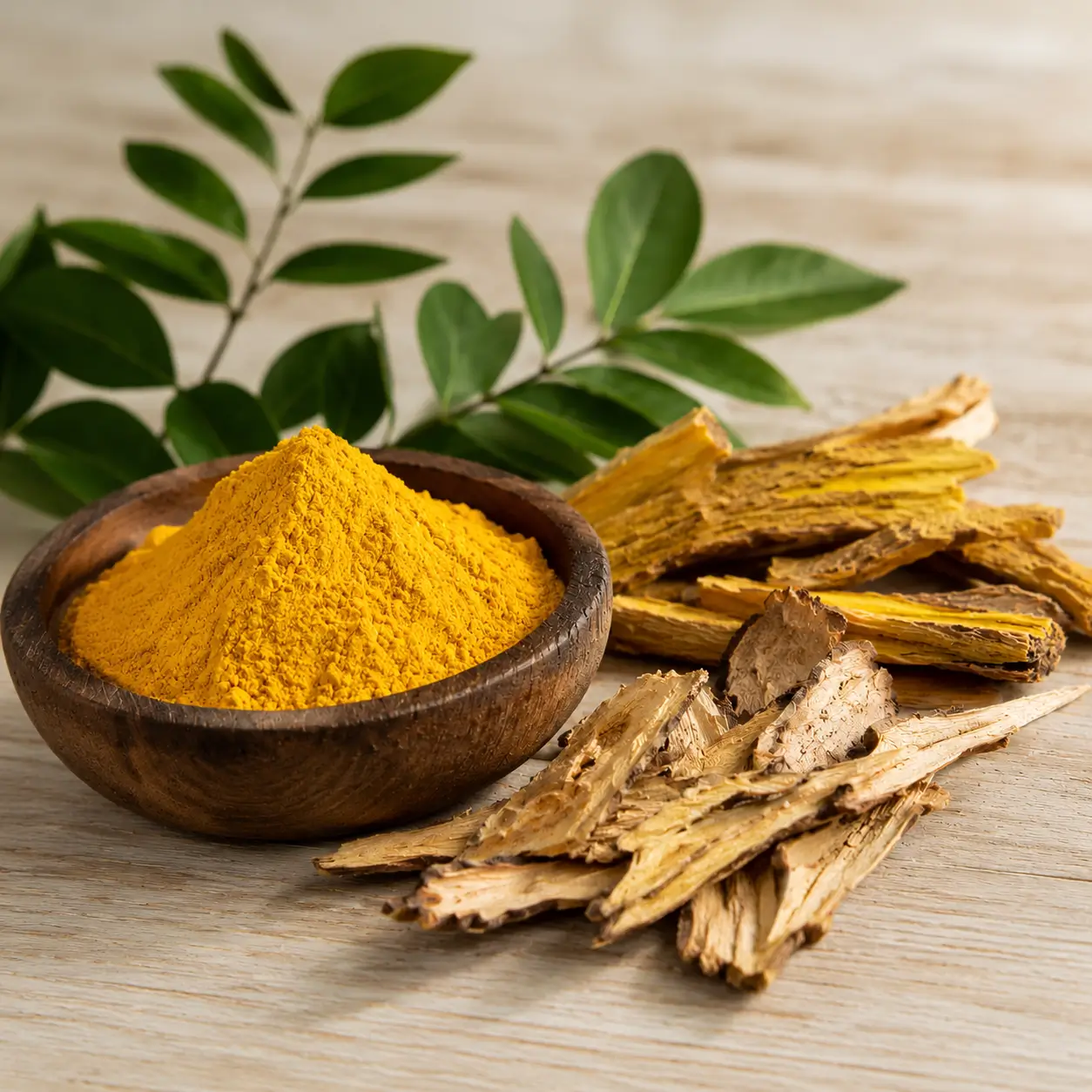
Berberine is extracted from plant roots, most often Indian barberry (Berberis aristata). A raw extract is a mixture: berberine plus other plant compounds, residual material and moisture. A label can legally state the weight of that extract — “500 mg berberine extract” — without saying how much of it is berberine.
The clinical trials, by contrast, used defined doses of berberine itself, typically 900 to 1,500 mg a day. If your capsule is mostly something else, you are not taking the dose the research studied, however many capsules you swallow.
If your capsule is mostly something else, you are not taking the dose the research studied.
How purity is actually measured
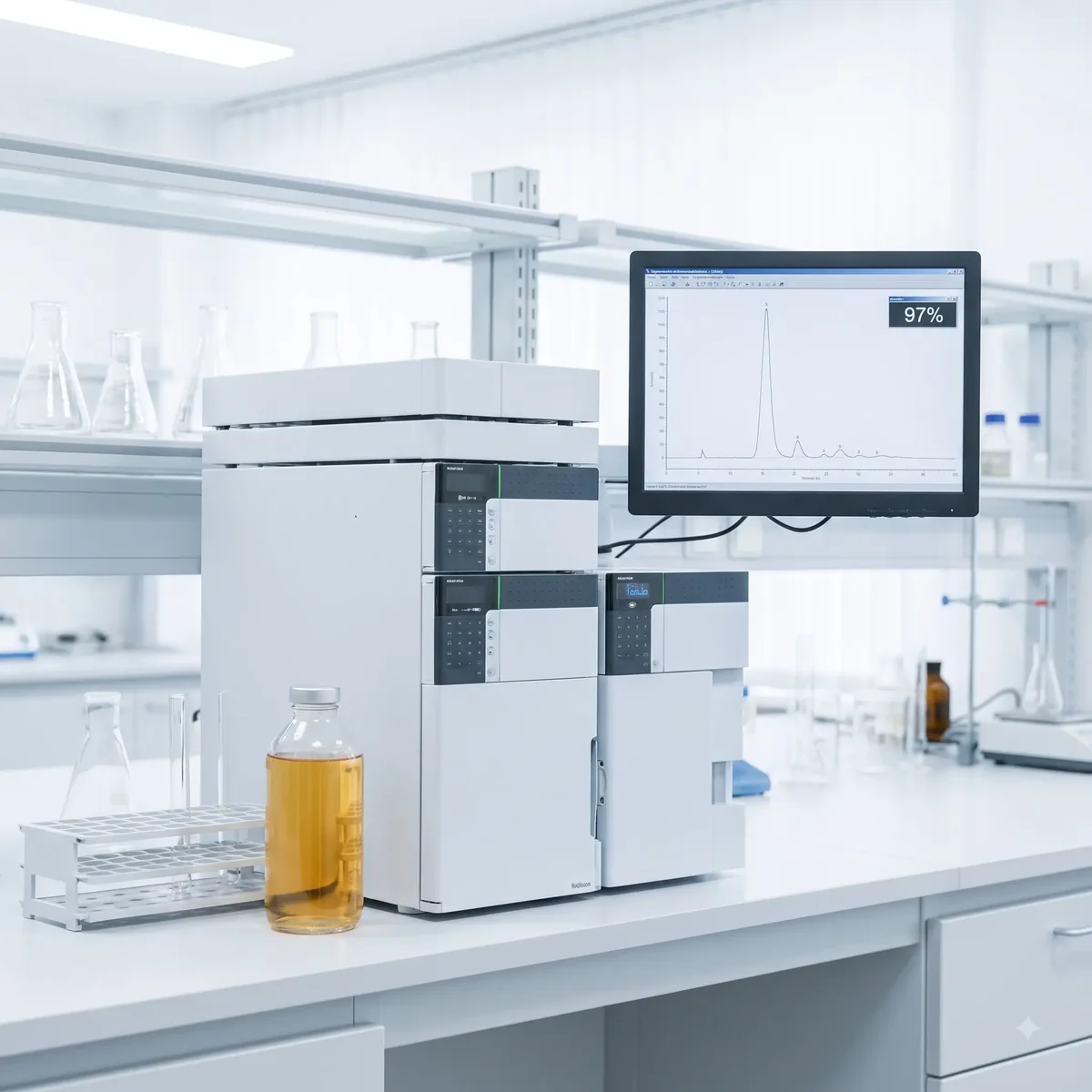
The standard technique is high-performance liquid chromatography, or HPLC. A dissolved sample is pushed at high pressure through a narrow column packed with a fine material that holds on to each compound in the mixture for a slightly different length of time. The compounds come out of the other end one after another.
A detector — usually one that measures how strongly each compound absorbs ultraviolet light — records them as a series of peaks. By comparing the berberine peak with a reference standard of known purity, the lab calculates exactly how much of the sample is berberine.
Official compendia such as the Japanese Pharmacopoeia publish monographs for berberine chloride that specify how it should be identified and assayed, and analytical methods are validated against international guidelines such as ICH Q2(R1). This is a far higher bar than a simple identity check or a weight on a label.
What a purity number does not tell you
An assay answers one question precisely: how much of the sample is the target molecule. It says nothing about what else is in the rest of it.
Pesticide residues, heavy metals and microbes are present, if at all, at tiny concentrations — parts per million or less — and are measured with entirely different instruments. A product can have an excellent purity result and never have been tested for contamination. A complete picture needs both.
How to read an assay result on a lab report
A genuine report, as opposed to a marketing graphic, will show all of the following:
- The name of the laboratory, with an address and a named, signing analyst.
- A sample name and a batch or lot number you can match to your bottle.
- The test (“Assay”), the method used, the result and its unit — g/100 g is the same as a percentage.
- A report number and dates of receipt and analysis.
A worked example
To make this concrete, here is how that looks on the assay report Beyond Better publishes for its current batch. The laboratory is Eureka Analytical Services. The sample is listed as Berberis aristata extract, batch CIFOW-11. The parameter is “Assay”, tested by the laboratory’s documented method, EKA-CHE-SOP-118, with a result of 99.68 g/100 g.
You do not need to be a chemist to check any of this. You only need a brand willing to show you the page.
Why the whole report should be public
Very few brands publish their test results. Some share a summary graphic; some send a certificate on request after you have paid. A few publish nothing and rely on the word “tested”.
The only claim a reader can rely on is one they can check before buying: a full report, for the batch they will receive, covering contamination as well as purity. Here are the five things to look for.
Questions that expose an empty claim
If a brand says its berberine is pure, ask:
- Is the dose stated as berberine hydrochloride, or only as “extract”?
- Which laboratory measured it, and can I see the report?
- Which batch does the report cover, and is that the batch I will receive?
- Was it tested for pesticides, heavy metals and microbes as well?
The bottom line
A purity number is only as good as the test behind it, and only as useful as your ability to read it. Extract weight is not active dose; HPLC is how the difference is measured; and purity is only half of quality. Ask to see the report — and favour brands that show it without being asked.
Reader questions
What does HPLC stand for?
High-performance liquid chromatography: a laboratory technique that separates the compounds in a sample and measures how much of each is present.
Is a purity claim on a label the same as a test result?
No. A label is a claim. Only a lab report for the batch shows what was actually measured, by whom and how.
Does high purity mean a product is clean?
No. Purity and contamination are separate questions. Pesticide residues, heavy metals and microbes need their own tests.
Why don’t all brands publish their reports?
Testing costs money, and publishing results invites comparison. Brands whose products would not compare well have little reason to show them.
Sources
- Japanese Pharmacopoeia, 18th Edition — Berberine Chloride Hydrate monograph. Ministry of Health, Labour and Welfare, Japan, 2021.
- ICH Q2(R1) — Validation of analytical procedures: text and methodology. International Council for Harmonisation, 2005.
- USP General Chapter <621> Chromatography. United States Pharmacopeia, 2023.
- Zhang Y et al. — Treatment of type 2 diabetes and dyslipidemia with the natural plant alkaloid berberine. Journal of Clinical Endocrinology & Metabolism, 2008.
More from the Journal
A Plant Extract Can Be 99% Pure and Still Carry Pesticide Residue. Here’s the Test That Catches It
‘Lab Tested’ Means Less Than You Think. Three Questions That Reveal Whether a Supplement Was Really Tested