A Plant Extract Can Be 99% Pure and Still Carry Pesticide Residue. Here’s the Test That Catches It
Berberine does not come from a factory. It comes from the root of a farmed plant — and anything sprayed on that field can travel into the extract. Why purity tests miss it, how residue screening works, and what to look for on a report.
When people imagine what might be wrong with a supplement, they usually picture too little of the active ingredient. That is a real risk. But with a plant extract there is a second one that gets far less attention: what else came along from the field.
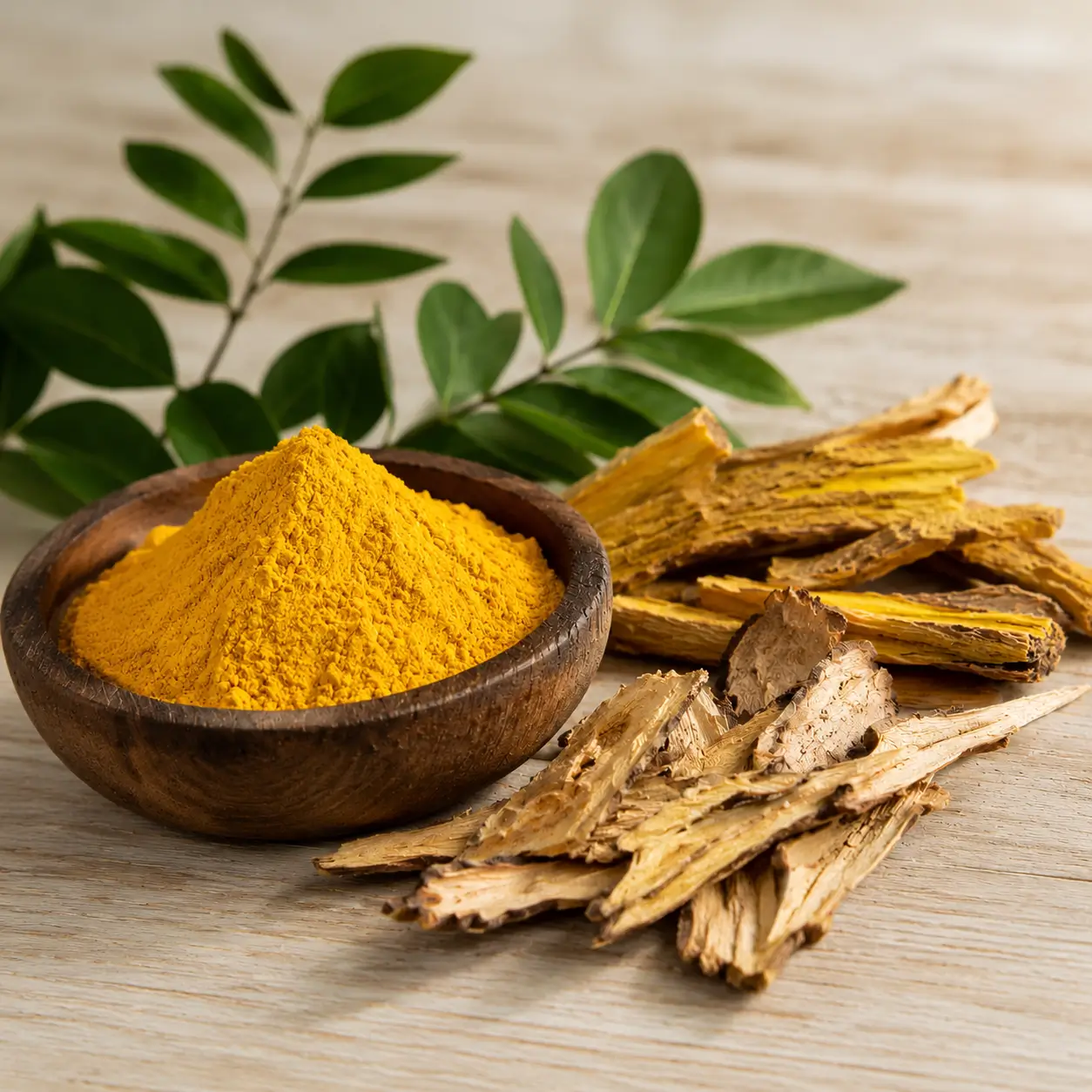
Berberine is a good example. It is extracted from the roots of plants such as Indian barberry (Berberis aristata), grown in soil, on farmland, often alongside other crops. Whatever was sprayed on or near those plants can end up in the root — and from there, in the extract.
Why botanicals carry a different risk
A synthetic ingredient starts from defined chemicals under controlled conditions. A botanical starts from a crop. That is not a reason to distrust plant extracts; it is the reason residue testing exists as its own discipline for them.
Standards bodies recognise this explicitly. The United States Pharmacopeia sets limits for pesticide residues in articles of botanical origin, and the World Health Organization publishes guidance on assessing herbal medicines for contaminants and residues.
Whatever was sprayed on or near those plants can end up in the root — and from there, in the extract.
Why a purity test cannot see it
A purity assay tells you how much of the sample is berberine. If a sample is 99% berberine, the assay has described the 99%. It has not characterised the remaining fraction, and it was never designed to.
Pesticide residues, when present, occur at tiny concentrations — measured in milligrams per kilogram or less. Detecting them takes different equipment and a different method altogether. That is why a supplement can have an impressive purity number and still never have been checked for residues.
How residue screening works
Modern laboratories use multi-residue methods that can look for hundreds of pesticides in a single sample. A common approach, standardised as AOAC Official Method 2007.01, extracts the residues with a technique called QuEChERS, then separates and identifies them using gas and liquid chromatography coupled to mass spectrometry.
The size of the panel matters. Pesticide use varies by region and crop, and a test only finds what it looks for. A panel of twenty compounds can only rule out those twenty. A panel of several hundred rules out far more.
How to read a residue result
A meaningful residue report is specific. Look for:
- The number of pesticides tested, ideally listed by name.
- The limit of quantification (LOQ) — the smallest amount the method can reliably measure.
- Results for each compound, or a statement that all were below the LOQ.
- A conclusion against a named standard, such as the EU’s Regulation (EC) No 396/2005 on maximum residue levels.
What one published report shows
For a concrete example, Beyond Better publishes the residue report for its current batch (CIFOW-11), tested by Eureka Analytical Services, an NABL-accredited laboratory. The panel lists 523 pesticides by name. Every one was below the limit of quantification — 0.01 mg/kg for almost all of them — and the laboratory concluded that the sample was in accordance with EU Regulation (EC) No 396/2005.
That is the level of detail to expect from any brand that claims its berberine is clean: the number tested, the limit, the result and the standard it was judged against.
“Clean” should come with a page number
Words like “pure”, “clean” and “tested” cost nothing to print. A residue report with a named laboratory, a batch number and a list of pesticides costs real money — which is exactly why so few brands publish one.
Before you buy any berberine, check whether the brand can answer these five questions.
Purity and cleanliness, together
The strongest quality picture puts both on the table: an assay showing how much berberine is in the product, and separate reports showing what is not — pesticides, heavy metals and microbes — all tied to the same batch.
The bottom line
Plant extracts begin in a field, so residue screening is not a luxury for them; it is basic due diligence. A purity number cannot see residues. A broad multi-residue panel, reported in full, can. If a brand calls its berberine clean, ask to see the page that proves it.
Reader questions
Why do herbal supplements need pesticide testing?
Because they are made from farmed plants. Anything the crop absorbed during cultivation can travel into the extract — a pathway that does not exist for synthetic ingredients.
Doesn’t a high purity percentage prove a product is clean?
No. A purity assay measures the target compound. Residues occur at trace levels and are detected by different methods.
What does “below LOQ” mean?
Below the limit of quantification: the amount, if any, was too small for the method to measure reliably.
Sources
- AOAC Official Method 2007.01 — Pesticide residues in foods by acetonitrile extraction and partitioning with magnesium sulfate (QuEChERS). AOAC International, 2007.
- USP General Chapter <561> Articles of Botanical Origin. United States Pharmacopeia, 2023.
- WHO guidelines for assessing quality of herbal medicines with reference to contaminants and residues. World Health Organization, 2007.
- Regulation (EC) No 396/2005 on maximum residue levels of pesticides in or on food and feed of plant and animal origin. European Union, 2005.
More from the Journal
The ‘500 mg’ on Your Supplement Label Might Not Mean What You Think
‘Lab Tested’ Means Less Than You Think. Three Questions That Reveal Whether a Supplement Was Really Tested