Eating Less but the Weight Won’t Move? Researchers Point to a Hormone Most Diets Ignore
Weight is usually framed as calories in, calories out. But insulin helps decide whether your body stores fat or burns it — and that is where berberine’s research gets interesting, and where the “nature’s Ozempic” hype gets it wrong.

You cut the sugar. You skipped dinner. You walked every morning for a month. And the scale barely moved — while the weight around your middle seemed to stay exactly where it was.
If that sounds familiar, it is not a failure of willpower. Body weight is regulated by hormones as much as by arithmetic, and one of them — insulin — has an outsized say over whether your body is in storage mode or burning mode.
That is also where berberine has attracted the attention of researchers. Not as a miracle, and not as a pill that melts fat, but as a compound that works on the machinery behind the scenes.
Insulin: the storage signal
Insulin’s job is to move glucose out of the blood and into cells. It also sends a second message: store, don’t burn. While insulin is high, the body holds on to fat and makes new fat more readily.
In a healthy metabolism, insulin rises after a meal and falls back between meals, opening a window in which stored fat can be used for fuel. In insulin resistance, cells respond sluggishly, so the pancreas keeps insulin elevated for longer to get the same job done. The window narrows. For much of the day, the body stays in storage mode.
That is one reason weight often gathers around the waist in people with insulin resistance, and why eating less does not always produce the result the arithmetic promises.
For much of the day, the body stays in storage mode.
Why the cravings are not about willpower
A meal that sends blood sugar soaring is often followed, a couple of hours later, by a drop. That drop is when the craving for something sweet or starchy arrives, reliably, at 4 p.m. or late at night.
Smoothing out those swings — through food order, protein and fibre, a walk after eating, and adequate sleep — tends to quieten the cravings more effectively than trying to resist them.
What berberine does inside fat metabolism
Berberine’s best-documented action is switching on AMPK, the cell’s energy sensor. When AMPK is active, it turns down the enzymes that build new fat and turns up the machinery that carries fat into the mitochondria to be burned. A 2009 study in the American Journal of Physiology described how berberine improves fat handling in obesity through exactly this switch.
Berberine also improves insulin sensitivity, so insulin can fall to lower levels between meals. And in the liver, it dampens the signals that drive new fat production — which is why berberine trials so often report falls in triglycerides.
What the human trials honestly show
Here is where honesty matters. In a 2012 study published in Phytomedicine, adults with obesity who took 500 mg of berberine three times a day for 12 weeks saw a mild average weight loss, alongside meaningful falls in triglycerides and cholesterol. Other trials in people with metabolic syndrome and polycystic ovary syndrome have reported modest reductions in weight, body-mass index and waist size.
Modest is the right word. For comparison, the prescription drug semaglutide produced an average weight loss of about 15% over 68 weeks in its landmark trial. Berberine does nothing of the sort, and anyone calling it “nature’s Ozempic” is selling you something the research does not support.
Berberine’s value for weight is quieter: better blood sugar control, lower triglycerides, fewer post-meal crashes, and a metabolism that spends more of the day able to use stored fat. Those changes support a sensible plan; they do not replace one.
A better goal than the number on the scale
If your weight gathers around your middle, your waist measurement and your blood markers are often more meaningful than your weight alone. They also respond earlier.
- Waist circumference, measured at the navel, first thing in the morning.
- Triglycerides and HDL cholesterol on a standard lipid profile.
- Fasting glucose, HbA1c and, if your doctor agrees, fasting insulin.
If you add berberine, make sure it contains berberine
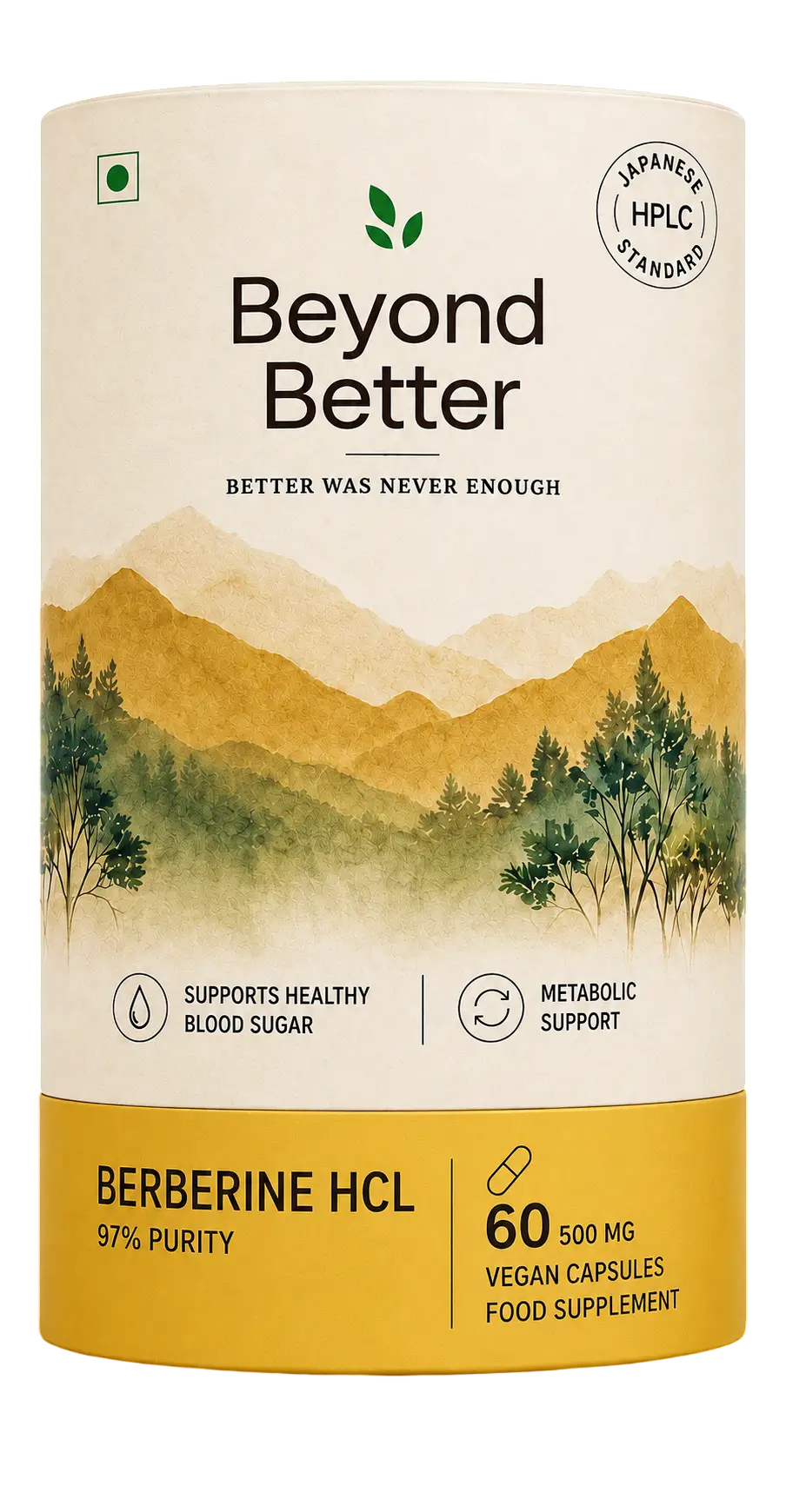
The weight-loss aisle is where supplement quality is at its worst, and berberine’s newfound popularity has attracted plenty of products that are more label than substance. A capsule can say “500 mg” on the front while delivering a fraction of that as active berberine hydrochloride.
Because berberine is extracted from a farmed root, it can also carry residues from the field. You cannot see any of this from the bottle. A lab report for the batch can show it. Here is what to check before you buy.
How to use it alongside a plan
Take berberine with your main meals — 500 mg with breakfast and 500 mg with dinner is a common routine within the range used in trials. Pair it with the things that move the needle most: protein at each meal, a walk after eating, strength training twice a week and seven or more hours of sleep.
Track your waist and your blood markers rather than weighing yourself daily, and judge the result after about 12 weeks.
The bottom line
Berberine is not a weight-loss drug, and the evidence does not support treating it like one. What it does — better insulin sensitivity, lower triglycerides, steadier blood sugar — addresses some of the reasons a sensible plan stalls. Used that way, with realistic expectations, it is one of the better-studied supplements in this space.
Reader questions
How much weight can berberine help me lose?
The trials show modest effects on weight and waist size over about three months, with clearer improvements in triglycerides and blood sugar. It supports a plan; it is not a weight-loss drug.
Is berberine the same as Ozempic?
No. Semaglutide is a prescription GLP-1 medicine with much larger effects on weight. Berberine works mainly through AMPK, a different pathway, and its effects are far smaller.
Does berberine work without diet changes?
Some effects appear regardless, but the benefits are clearly greater alongside better food, activity and sleep.
Sources
- Hu Y et al. — Lipid-lowering effect of berberine in human subjects and rats. Phytomedicine, 2012.
- Kim WS et al. — Berberine improves lipid dysregulation in obesity by controlling central and peripheral AMPK activity. American Journal of Physiology — Endocrinology and Metabolism, 2009.
- Zhang Y et al. — Treatment of type 2 diabetes and dyslipidemia with the natural plant alkaloid berberine. Journal of Clinical Endocrinology & Metabolism, 2008.
- Wei W et al. — A clinical study on the short-term effect of berberine in comparison to metformin on the metabolic characteristics of women with polycystic ovary syndrome. European Journal of Endocrinology, 2012.
- Wilding JPH et al. — Once-weekly semaglutide in adults with overweight or obesity. New England Journal of Medicine, 2021.
More from the Journal
Is Berberine Really ‘Nature’s Ozempic’? We Checked the Viral Claim Against the Science

The Blood Test Most People Are Never Offered — and Why It Can Flag Trouble Years Before Your Sugar Rises